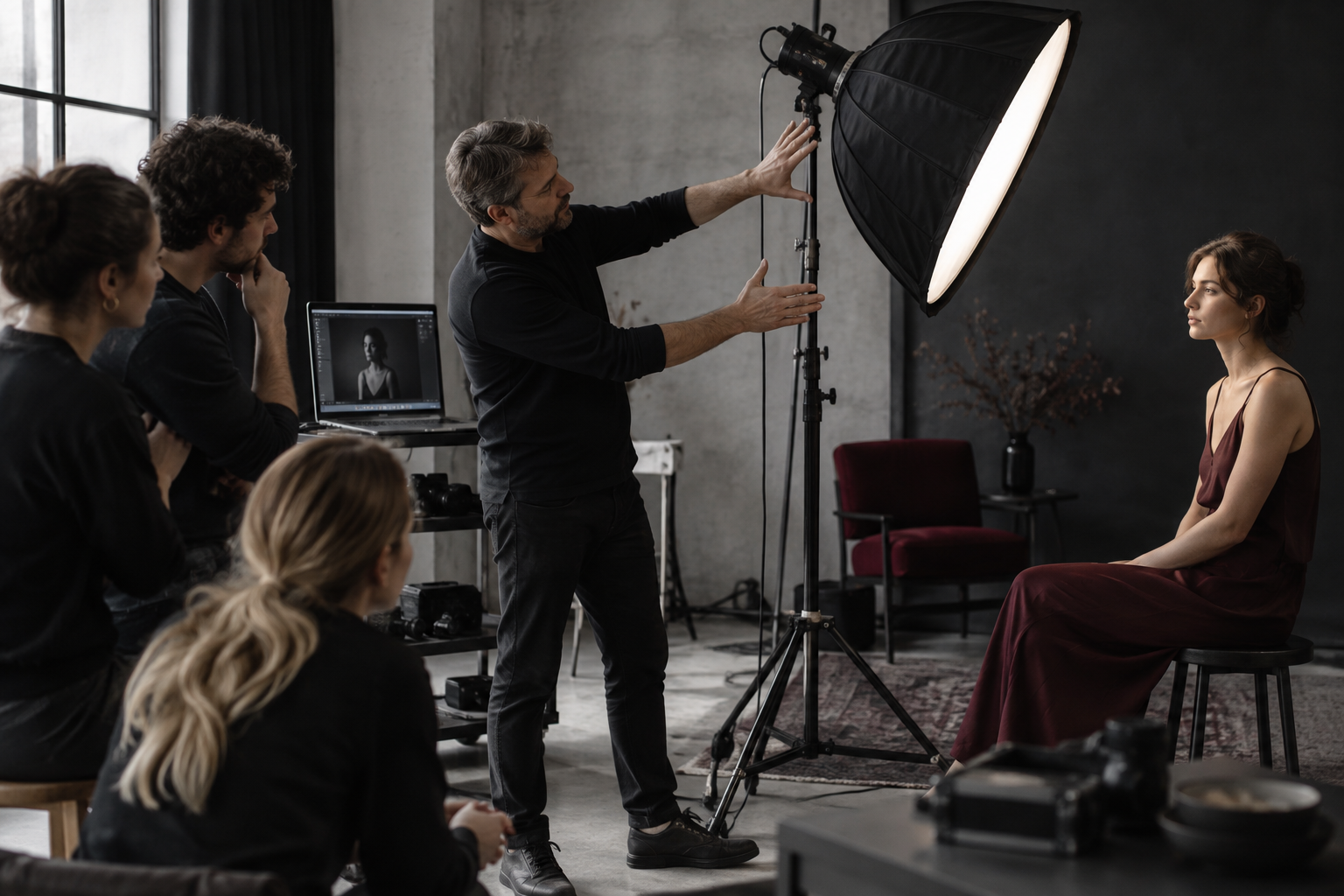
A useful lighting workshop should help you understand why a setup works and give you time to practise. Check the programme, prerequisites and individual shooting time before booking.
This article is an evergreen adaptation of our earlier workshop announcement. It does not confirm a particular date, group size, online recording or current event package.
Turn uncertainty into learning goals
If you normally work with daylight, write down what feels unfamiliar: flash triggering, modifier choice, power, direction or guiding a model while managing the equipment. A focused question makes it easier to choose a relevant class.
Look for a programme that explains the source, modifier and placement before adding complexity. You should be able to connect a change in the setup with a visible change in the photograph. Copying a finished scene is less useful if you cannot rebuild it later.
Check how practice is organised
Ask whether you will set lights yourself, observe a demonstration or photograph an already prepared scene. Find out how participants take turns and whether the tutor discusses their results. "Small group" alone does not tell you how much individual practice you will receive.
Confirm whether the event uses continuous light or flash and which cameras or phones are suitable. Ask what you need to bring rather than assuming equipment is supplied. For English-speaking attendees, confirm the teaching language before payment.
Arrive ready to test
Bring the agreed equipment, charged batteries, empty cards and questions. Know the basic controls of your camera so that the session can focus on light. Take notes about distances and angles, not only power numbers that may not transfer to another device.
Repeat the exercise afterwards
Rebuild one setup, change one element and compare. A reference guide can support this practice: see KARIROOM's lighting setups ebook. The PDF is in Polish; the English product page explains that distinction.
Is a workshop the same as a course?
Not usually. A course often builds broader foundations, while a workshop concentrates on a particular skill. Read the programme rather than relying on the label.
Will I receive portfolio-ready files?
Cover: editorial illustration. It does not depict an actual KARIROOM room, included equipment, client session or preset result.